Editorial Cartoonists and Their Work
BROWSE ALL IMAGES IN THIS COLLECTION
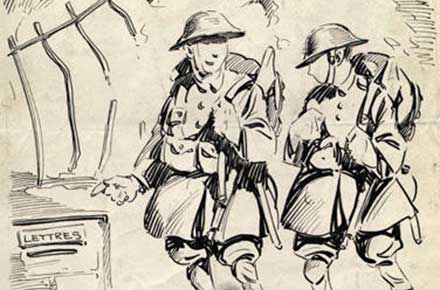
Roy Grove World War I cartoon.
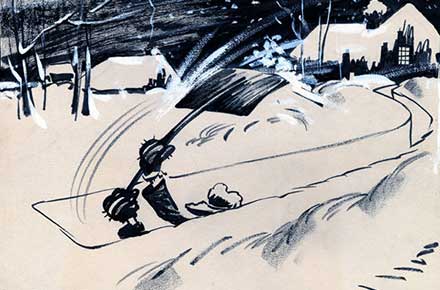
"Day After Day!" by Willard Combes, 1944.
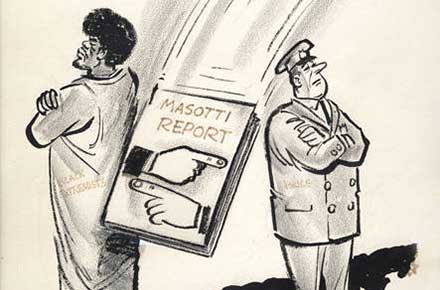
"Glenville Violence" by Bill Roberts.
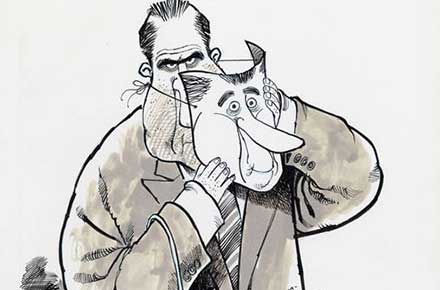
"Trick or Treat?" by Ray Osrin, 1973.
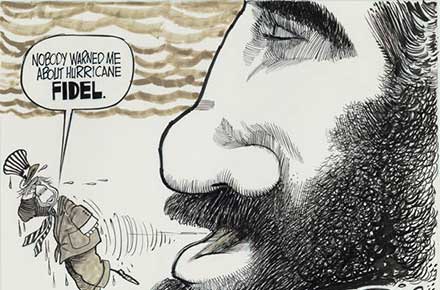
"Hurricane Fidel" by Ray Osrin, 1979.
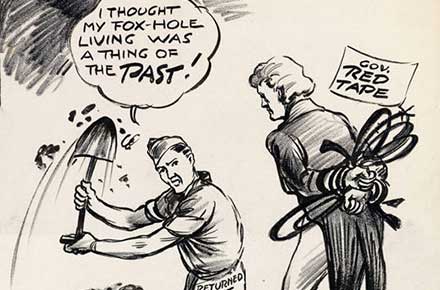
"The Battle of the Home Front!" by Willard Combes, 1945.
Because of its strong publishing and artistic tradition, Cleveland has been blessed with many talented graphic artists, including some who worked for the city's major newspapers. Use this page as a pathfinder to resources about some of the area's more notable editorial cartoonists of the last century.
Willard W. Combes (1901 - 1984)
Willard W. Combes was an editorial cartoonist for the Cleveland Press for 28 years from 1934 to 1962. A native Clevelander, he graduated from Glenville High and the Cleveland School of Art. Combes was also a teacher at the Cleveland School of Art (now the Cleveland Institute of Art) and the Western Reserve University School of Architecture (now Case Western Reserve University). In addition to his work as an editorial cartoonist, Combes was a portraitist, stained glass artist, and a muralist, lending his talent in the latter area to murals at Lutheran High School East and St. Luke's Church in Lakewood.
For more, read his entry from The Encyclopedia of Cleveland History.
- Combes cartoons and photos in Cleveland Memory
- Encoded Archival Description (EAD) finding aids for archival material about Combes in Ohio
Roy Grove (1893 - 1958)
From
1917 through the mid-1920s, Roy Grove was a cartoonist with the Newspaper Enterprise Association (NEA), one of the first newspaper syndicates. During World War I he traveled to Great Britain, France, Switzerland and Italy, supplying the NEA with cartoons and art, many appearing in The Cleveland Press.
Read more about Roy Grove.
James Harrison Donahey (1875 - 1949)
James Harrison (Hal) Donahey was the chief editorial cartoonist for the Plain Dealer from 1900 to 1949. Born in Tuscarawas County, Donahey moved up to Cleveland to study at the Cleveland School of Art. Before working for the Plain Dealer, Donahey worked for the Ohio Democrat in New Philadelphia and as an illustrator for the Cleveland World. According to A History of Cleveland (vol.1), "As a cartoonist Donahey wields an exceedingly clever pencil; his humor is never offensive and shows the man of heart. He is of a creative mind, studious, modest, and altogether a charming fellow, and a real artist." (p. 466)
Reporter Lawrence J. Hawking wrote about Donahey in a 1939 Plain Dealer article:
He was the first to bring artistry to the cartoon; he has been credited with swinging Cleveland elections; he has helped to make and unmake presidents, and he has known them all since 1900; his work has been reprinted in the best magazines, and at one time "Donahey" and "Plain Dealer" meant the same thing.
For more, read his entry from The Encyclopedia of Cleveland History.
Jim Herron (1908 - 1987)
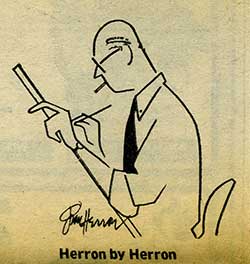
Jim Herron was the cover artist for the weekly "Showtime" entertainment section of the Cleveland Press from its inception in 1962 until his retirement as chief of the editorial art department in 1978. He was also an expert in fashion sketching and layout, a watercolorist and, at times, an editorial cartoonist, but Herron's preference was doing caricatures of theater people, some of which are on display at the Cleveland Museum of Art.
Born in New Philadelphia, Ohio with the Welsh name Dorwyn Rennels Herron, he was known as Jim or James throughout his life, though he never legally changed it. He started drawing when he was 7, and when the family moved to Cleveland, he attended Shaw High School in East Cleveland, where he took art classes.
During his senior year, Herron's father died so he left school for a job in the drafting department in a local firm and then became a copy boy at United Press wire service. In 1927, Herron started working for the Cleveland Press and at night he continued to study art at the John Huntington Polytechnic Institute.
A Cleveland Press article (Jan. 12, 1978) written by Jim Frankel about Jim Herron at the time of his retirement describes Herron's signature style:
His strokes were always bold, ever imaginative, resourceful and innovative. Even now, a half a century after he began here, his ideas are fresh and vital as when I first encountered him three decades ago.
True, he grimaces at covers depicting rock groups, but he still fancies them up in the style they deserve.
But as an editorial said of Jim in 1963 (timed to salute a one-man show at a gallery), "The caricatures ... though lively, never carry a trace of malice."
Edward D. Kuekes (1901 - 1987)
Edward D. Kuekes worked for the Plain Dealer from 1922-1966, first as James H. Donahey's "understudy", then as editorial cartoonist shortly after Donahey's death in 1949. Kuekes was awarded a Pulitzer Prize in 1953 for his editorial cartoon, "Aftermath," which commented on the death of young American soldiers during the Korean War who were not even old enough to vote. The cartoon was published on the front page of the Plain Dealer on November 9, 1952.
For more, read his entry from The Encyclopedia of Cleveland History.
- Edward D. Kuekes Cartoons - An inventory of his cartoons at the Special Collections Research Center,
Syracuse University Library. - "Edward D. Kuekes Is Named Cartoonist of Plain Dealer" - PD article from June 4, 1949 as reproduced in Stripper's Guide, a blog that discusses the history of the American newspaper comic strip.
Ray Osrin (1928 - 2001)
Born in Brooklyn, New York, Ray Osrin came to Cleveland by way of Pittsburgh, PA where he was an illustrator and cartoonist for the Pittsburgh Press from 1958 to 1963. In 1963, Osrin started out as a staff artist for the Plain Dealer, and upon Edward Kuekes' retirement in 1966, became the editorial cartoonist, a job he held until his own retirement in 1993. According to his Plain Dealer obituary (April 4, 2001) written by Alana Baranick:
"With his often curmudgeonly attitude, his Brooklyn [N.Y.] lack of confidence in any institution and his delightful sense of humor, Osrin was an equal-opportunity offender," said former Plain Dealer editorial page editor David Molyneaux. "He poked fun at everyone and everything, including himself."
- Osrin cartoons and photos in Cleveland Memory
- Encoded Archival Description (EAD) finding aids for archival material about Osrin in Ohio
- Transcript of an interview with Ray Osrin, March 4, 1992 (from Youngstown State University Oral History Collection)
- The Wizard of Osrin - An episode from the television documentary series, Montage. This film follows Osrin's creative process in making illustrated editorials from the conception of an idea to the finished product, an editorial cartoon.
Bill Roberts (1914-1978)
William E. (Bill) Roberts worked for the Cleveland Press from 1932 until 1978. A Cleveland native and West High School graduate, Roberts first started working for The Press by contributing drawings and a weekly cartoon called the "Weeks Wash" to the sports section. In 1962, he succeeded the retiring Willard Combes as Editorial Cartoonist for the Cleveland Press. Though at the The Press his cartoons focused on local and state affairs, as a frequent replacement for vacationing Scripps-Howard cartoonists, Roberts was able to flex his editorial muscle on a state and national level. These cartoons gained recognition from several U.S. presidents — Lyndon Johnson kept autographed copies of some of Roberts' work and copies of Roberts' work can be found in Johnson's presidential library as well as the presidential libraries of Richard Nixon and Gerald Ford.
In May 1954, Roberts completed painting a 70 foot mural for Kornman's Restaurant depicting cartoon likenesses of local personalities and politicos of the time. The mural hung at The Press Club of Cleveland for a time and was later donated to the Western Reserve Historical Society. A reproduction currently hangs at Nighttown, a restaurant/jazz club in Cleveland Heights and the "official clubhouse" for The Press Club of Cleveland.
For more about Roberts, read his entry from The Encyclopedia of Cleveland History.
- Reproduction of Roberts' Press Club mural
- Encoded Archival Description (EAD) finding aids for archival material about Roberts in Ohio
Resources Consulted:
Baranick, Alana. "Ray Osrin , cartoonist who used his pen like a sword." The Plain Dealer, Apr. 4, 2001, 7B.
Hawking, Lawrence J. "Donahey Cartoons Fill 40-Year File: Ohioan Who Mirrors Nation's Life Has Served Plain Dealer Since Century's Turn." The Plain Dealer, Dec. 31, 1939, 1A
"Jim Herron, Press caricaturist." The Plain Dealer, Jun. 15, 1987, 16C.
Jirousek, Carolyn S. Provocative Pens : Four Cleveland Cartoonists. Cleveland, Ohio: Cleveland Artists Foundation, 1922.
Orth, Samuel Peter and S. J. Clark, S.J. A History of Cleveland, Ohio. Chicago-Cleveland: S.J. Clark Pub. Co., 1910.
Van Tassel, David D. and John J.Grabowski. Encyclopedia of Cleveland History 2nd edition. Bloomington: Indiana University Press in association with Case Western Reserve University and the Western Reserve Historical Society, 1996.


