
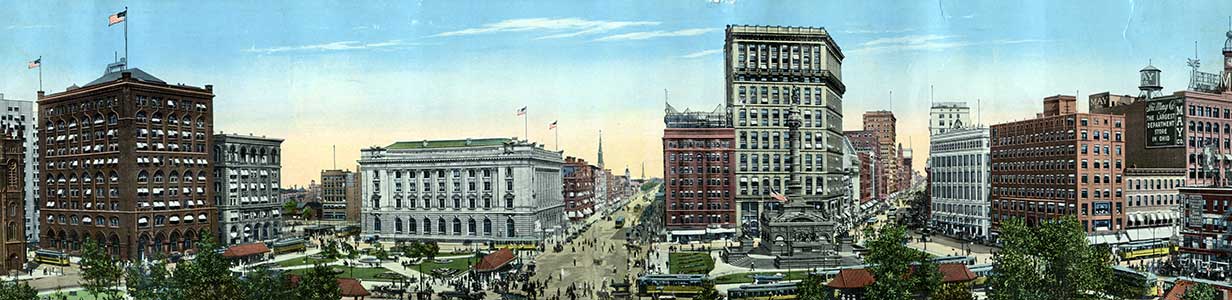
Lithuanian Americans of Cleveland
BROWSE ALL ITEMS IN THIS COLLECTION
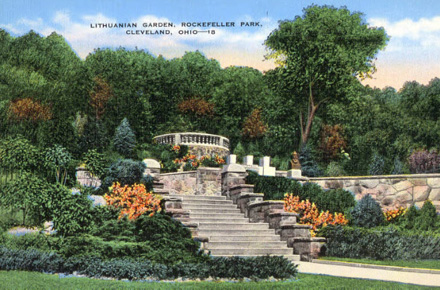
Lithuanian Garden, Rockefeller Park, c. 1942
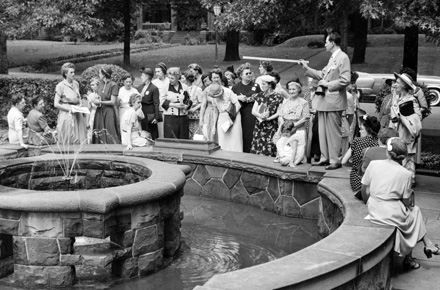
a 1950 tour of the Lithuanian Cultural Garden.
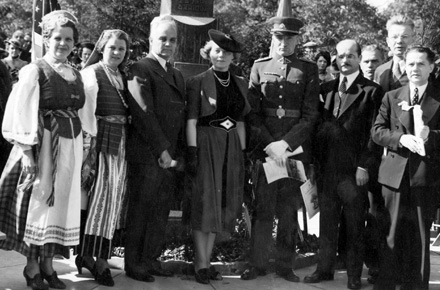
Dedication of the bust of Lithuanian patriot Basanavicius, 1938.
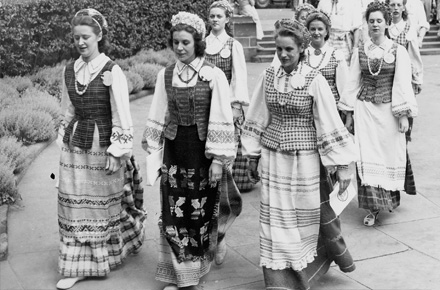
Procession at Lithuanian Cultural Garden, 1950.
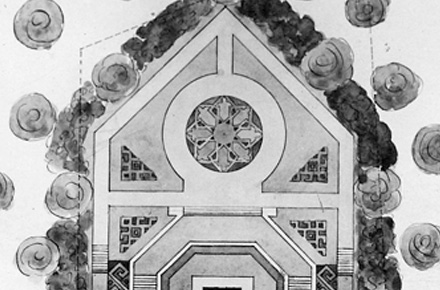
a 1931 Plan of Lithuanian Cultural Garden, detail.
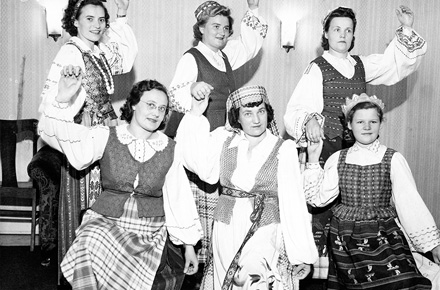
Lithuanian folk dancers, 1948.
According to the Encyclopedia of Cleveland History, Cleveland's Lithuanian community "is recognized as one of the most active and productive in terms of organizational activity, community consciousness, political and civic involvement in the general affairs of Greater Cleveland, literary activity and the arts, and folk art ensembles, and is the home community of numerous persons prominent in various fields among the Lithuanian nation worldwide."
Lithuanians began arriving in Cleveland as early as the 1870's, soon establishing St. George's Catholic Church, which eventually rose in its present location at E. 67th and Superior. A second church, Our Lady of Perpetual Help, was founded in the former Nottingham Village (now Collinwood) in 1929. Dozens of Lithuanian businesses, newspapers, benevolent groups and community organizations began to thrive in the area surrounding St. George's, including Cleveland's Lithuanian Club, founded in 1920. Although the Club's original building was burned down in 1971, the Lithuanian Community Center and Club continues to thrive in its new home on East 185th Street in Cleveland. By the mid-1980's, the Lithuanian community numbered about 16,000.
Photos, documents, and media in this collection originate from the holdings of Cleveland State University's Special Collections, from the Lithuanian Village, and from individual donors and contributors.
Exhibit Features:
ORAL HISTORIES
- Grace Kudukis interviewed May 1, 1986 for Cleveland Memory's Ethnic Women in Cleveland series
This oral history, collected in 1986, provides a look at one of Cleveland's leaders. President of Belkin Kudukis Film Production Services, Grace Kudukis has headed the League of Women Voters and was instrumental in bringing the 1980 Presidential debates between Reagan and Carter to Cleveland. After Lithuania's independence in the early 1990s, she helped CNN and the Peace Corps establish themselves there. Klaipeda, Lithuania and Cleveland, Ohio are sister cities due in part to her efforts. - Milda Lenkauskas interviewed May 22, 1986 for Cleveland Memory's Ethnic Women in Cleveland series
An active member of Lithuanian community, the Cleveland representative of the Lithuanian Foundation for 12 years and the Vice-president for Cultural Affairs. She was also involved with the World Lithuanian Community. Moreover, Mrs. Lenkauskas spent 6 years on the Board of Directors of the Nationalities Services Center. Milda Lenkauskas is also a mother of three daughters, and each one of them contributed significantly to the Lithuanian community. All of them belonged to various cultural groups, such as folk dance group "Grandinele" and the Lithuanian girls singing ensemble "Nerija". - Frank Lucas interviewed September 15, 2011 for the Sacred Landmark Series of the Center For Public History & Digital Humanities Oral History Project
This is an interview conducted with Frank Lucas, Parish Council President of St. Casimir parish, formerly Our Lady of Perpetual Help. The interview begins with talk of the formation of the parish in 1929 to accommodate the growing Lithuanian community in the Collinwood and Euclid neighborhoods. The first part of the interview traces the location of the parish in the early years along with a growing parish community. In 1953 a new church was dedicated and the school and auditorium were built later. As the interview continues talk of parish life and Lithuanian culture continues. In the later part of the interview discussion is over architectural details of the church, merging parishes and balancing Lithuanian identity. - Roman Zorska interviewed November 30, 2009 for the Cleveland Cultural Gardens Series of the Center For Public History & Digital Humanities Oral History Project
A delegate of the Lithuanian Cultural Garden, Roman Zorska discusses the history of the Lithuanian Cultural Garden and reflects on his own life. An immigrant from Lithuania, Mr. Zorska came to Cleveland in December of 1949 as a young boy. He discusses where he went to school, where he lived, and his life in Cleveland growing up. He also discusses the areas Lithuanians lived within Cleveland, the changing demographics within city limits, and Lithuanian history and culture. The bulk of the discussion revolves around the busts within, history of, and future plans of the Lithuanian Cultural Garden. Other topics include the Cultural Garden Federation, restoration of the gardens, and the Cleveland Cultural Gardens as a whole.
Image Collections:
- Ciurlionis Lithuanian National Art Ensemble
- Funerals
- Lithuanian Cultural Gardens
- Lithuanian Independence Day
- Lithuanian Scouts
- Our Lady of Perpetual Help
- Sports
- St. George’s Church
- Weddings
Off-site Resources: a Pathfinder
- Dirva
Established in Cleveland in 1916, Dirva is one of the last Lithuanian newspapers still published in the United States. More about Dirva- Digitized issues of Dirva going back to 1917 are available from Spauda.org
- The Library of Congress has digitized issues from 1943-1951
- Recent issues are available in print and on microfilm from the Western Reserve Historical Society in Cleveland.
- History of Our Lady of Perpetual Help Parish (in Lithuanian and English) From Aidai.eu cultural magazine. Published for over 80 years, issues from 1944 - 1991 are digitized and available here.
- Photographs from St. Casimir Parish (Lithuanian) at Our Lady of Perpetual Help Church Flickr account containing hundreds of albums and nearly 4,000 images
- Lithuanian-American Citizens Club on Facebook
- Lithuanian Cultural Garden at Clevland Cultural Gardens
- Lithuanians in Cleveland at ClevelandPeople.com
- Lithuanians of Cleveland ltcle.org, an information resource for the Lithuanian-American community in Cleveland, Northeast Ohio, and beyond. Sponsored by Lithuanian Center Inc., also known as Pletrafund.org, and developed in cooperation with a number of local organizations.
VIDEO
-
This selection of dozens of videos from Dan Hanson documents a vital and very active Lithuanian community in Cleveland. Features include Lithuanian folk dancers and choirs, a folk costume fashion show, demonstrations of Pysanka Easter egg technique, short talks on subjects ranging from the history of the community in Cleveland to international politics to traditional foods, and documentation of various noteworthy community events.
LINKS TO COMMUNITY ORGANIZATIONS, PUBLICATIONS, & IMAGE COLLECIONS
ESSENTIAL READING
- E-book: Lithuanian Americans and Their Communities of Cleveland, by John F. Cadzow (1978)
- E-book: The Lithuanians of Cleveland (1920), by Charles Wellsley Coulter
- Articles from The Encyclopedia of Cleveland History:
- Antanas Smetona, exiled president of Lithuania, and Cleveland resident.
- Ciurlionis Lithuanian National Art Ensemble
- Dirva Cleveland's major Lithuanian-language newspaper, launched in 1916.
- Global True Lithuania/Ohio Encyclopedia of Lithuanian heritage worldwide
- Lithuanians Following historical patterns similar to those of other East European nations. the first wave of immigrants came to Clevland at the turn of the century (1890-1910).
- St. George's Lithuanian Church Established in 1901, St. George's was the first church for Roman Catholic Lithuanians in the Diocese of Cleveland.
- Telshe Yeshiva an internationally renowned center for traditional Jewish Scholarship and learning, established in 1875 in the town of Telsiai (also known as Telse), Lithuania.
LITHUANIAN ARTISTS WITH CLEVELAND TIES
- Alexander Blazys (1894-1963) was a Lithuanian-born American sculptor who grew up in Cleveland after immigrating as a child. He studied at the Cleveland School of Art beginning at age fifteen, later continuing his training in New York and Paris, where he worked with leading academic sculptors at the Académie Colarossi and École des Beaux-Arts. Blazys won first prize for sculpture at the Cleveland Museum's annual May Shows three years running (1926-1928). His style merged rhythmic movement inspired by music with Cubist geometric planes, and he also designed ceramic pieces for Cowan Pottery.
- Max Kalish (1891-1945) was a Lithuanian-born American sculptor who grew up in Cleveland after immigrating as a child. He studied at the Cleveland School of Art beginning at age fifteen, later continuing his training in New York and Paris at the Académie Colarossi and École des Beaux-Arts. Kalish became known for his series of small-scale figures depicting American laborers, many of which were developed during the 1920s while he worked between Cleveland and Paris. His work emphasized solid, simplified forms and careful observation of posture and gesture, conveying the dignity and physical strain of industrial life. Though he later established a studio in New York, his early training and subject matter remained closely tied to Cleveland.
- Paul "Toppy" Toppelstein (1925-2022) was a Cleveland photographer whose career began during World War II, when he served with the Army Air Forces processing aerial reconnaissance film from bombing missions over Europe. After his discharge in 1945, he joined the Newspaper Enterprise Association and later the Cleveland Press, where he remained as a studio photographer until the paper’s closure in 1982. Entirely self-taught, Toppelstein developed a straightforward, documentary style shaped by photojournalism. His work emphasized clarity, timing, and human interest, capturing everyday life and local personalities with an unembellished, observational approach that reflected Cleveland’s mid-century press culture.
RESEARCH COLLECTIONS IN THE UNITED STATES
- The Balzekas Museum of Lithuanian Culture
Founded in Chicago in 1966, the Balzekas Museum is the largest repository of Lithuanian cultural artifacts outside of Lithuania. - Lithuanian Archival Holdings at Kent State University
Materials in this collection of particular interest to Cleveland Lithuanians include:- Joseph Angelaitis collection - Materials documenting Lithuanian immigrants in Cleveland, Ohio and Pennsylvania, especially during the 1940s and 1950s. Father Joseph Angelaitis was the pastor of Cleveland's Our Lady of Perpetual Help Church from 1939-74.
- Lithuanian Village, Inc. - Includes three scrapbooks/record books on this Cleveland-based organization from 1961-1987.
For more information, contact the Kent State University Library department of Special Collections and Archives.
- The Lithuanian Research and Studies Center
Located in Chicago, this is the largest scholarly archive and book publisher outside of Lithuania
Acknowledgements
Lithuanian Americans of Cleveland, supported in part by a bequest from Charlotte Adomaitis, is part of the Cleveland Memory Project, and is one of a growing series of websites developed by the Michael Schwartz Library at Cleveland State University to explore the ethnic influences that helped shape the history and development of Cleveland.


